Showing posts with label Wolfgang Amadeus Mozart. Show all posts

Thursday, 20 August 2026

Mozart - Die Zauberflöte (Aix-en-Provence, 2026)

Wolfgang Amadeus Mozart - Die Zauberflöte (Aix-en-Provence, 2026)

Festival d'Aix-en Prevence, 2026

Leonardo García Alarcón, Clément Cogitore, Ying Fang, Mauro Peter, Sabine Devieilhe, Sean Michael Plumb, Brindley Sherratt, Edwin Crossley-Mercer, Alix Le Saux, Ashley Dixon, Adriana Bignagni Lesca, Emma Fekete, Rodolphe Briand, Damien Pass, Jonghyun Park, Yvon Moltzen, Jakob Geppert, Cléo Lou Straka, Zoé Höche

ARTE Concert - 21st July 2026

It's amazing - I think so anyway - how a great work of operatic art can be continually refreshed and revitalised hundreds of years after its creation, always having something new to tell us about our own times. That's the measure of great art of course and a great artform. Indeed there are few works in opera as enduring, as complete and unchallengingly brilliant as Mozart's Die Zauberflöte (although I can think of several other Mozart operas alone that fit that description). It's amazing how this can be achieved also with a minimal lightness of musical and directorial touch and without compromising the original mood and intent of the work. With a background in filmmaking, French director Clément Cogitore, sets out his stall for this production at the 2026 Aix-en-Provence Festival with simple grainy old movie footage, placing you in the world this particular Zauberflöte is going to inhabit, work its magic and share all its warmth, wisdom and love for humanity.

It's a historical period, but the implications and the human resonance of the WWII period chosen are not difficult to see applying to the contemporary world situation around us today. The opening footage is of people emerging out of the ruins of Berlin in the aftermath of the Second World War, the characters on the stage extending this out into the theatre and seeming to bring the audience into it, stepping back into time and really feeling like you are there in the midst of it. The focus is on clearing up and rebuilding, particularly from the perspective of the need to provide instruction and guidance to the children who have been left with a destroyed present and an unpromising future.

It's a thoughtful response to Mozart's opera on the part of the director, who by placing it in this setting captures the character emerging from an age of darkness much more effectively than the more typical magical fantasy setting ever manages to achieve. More than just delving deeper, Cogitore also attempts to widen the journey that Tamino and Pamina take to dig their way out of this bleak world by using children to stand in for the tenor and soprano singers as they pass through childhood and adolescence before the singers take over as young adults. There's a minor concern that the production might lose some of the 'magic' of The Magic Flute - and it has to be said that there is certainly less comedy playing in this version - but Die Zauberflöte is an opera of many dimensions, moods and colours and it can be instructive to focus on other aspects.

Cogitore's focus is indeed on the 'instructive' side of the opera. In Act I, Tamino is a child, struggling to survive amid the rubble and ruins; as is Papageno, doing what he can to get by with the meagre opportunities for finding food. The three ladies are dressed like those seen in the historical footage clearing bricks from the ruins, doing what they can to restore order and purpose, educating the children, providing food and providing protection from Tamino's terrifying dreams of snakes, setting the young boy a challenge to bring hope and a sense of purpose. The spoken dialogue is slightly adapted to the post-war situation in this way without changing the tone and intent of the original. It also brings a human element to the work. Not mythical figures, but people who have suffered real hardships and fears.

Further footage underlines the sense of purpose, the three boys a supportive gang of Tom Sawyers and Huckleberry Finns. Pamina meanwhile is in great danger on the streets of New York, encountering or trying to keep out of the clutches of Monostatos as a New York policeman or security guard. Her mother, the Queen of the Night is indeed just a mother who has lost her daughter to the promise of the bright lights of the city, with all the concerns that brings. And of course, with Tamino and Pamina starting out in this way as young children, it brings greater emphasis on the dangers they face as they make a necessary journey to rebuild a new world shaped by a fresh new outlook, not to be subject to the old ways of ancient orders and ancient enmities. Which in this case means a path that is not pre-determined by either the Queen of the Night or Sarastro.

There is a natural shift that takes place in Act II and the director gives the opening dialogue before 'O Isis und Osiris' time to make its point and establish where we are in the next stage in Tamino and Pamina's journey, the young children now adolescents. Reflecting the dress of Monostatos as a New York officer of the peace - a corrupt one - in Act I, we now find ourselves in what looks like a booming post-war Golden Age of Capitalism of the 1940s into the 1950s. Sarastro is the blind president of a large company, taking questions from his 'shareholders' on the suitability of the new junior executive protégé he has in mind to presumably take over the running of the company. Or something along those lines. The 'company' seems to be involved in scientific research of a dubious nature and the outcome of the 'recruitment process' is a little more ambiguous than usual at the conclusion.

The production certainly puts a different complexion on the opera's central conflict of enlightenment versus obscurantism, reason versus superstition, peace over aggression, but ends up coming to the same conclusion that a new generation can (or needs to) learn from the conflicts and failings of the previous generation and lead humanity "in joy and peace towards a better world". It's an optimistic view inspired by the Age of Enlightenment that hasn't quite come to fruition: if we have undoubtedly made some progress there have been huge steps backward as well. The projections of the brave new world of the post-war boom USA does reflect the ambiguity of this and make its failings recognisable, although perhaps wisely the production team avoid the rather negative portrayal of the dark skinned Monostatos as a reflection of race issues in the USA.

Under the musical direction of Leonardo García Alarcón - whose background is more in early baroque opera - the overture takes off at full tilt, but thereafter is filled with all the warmth, optimism, character and beauty of the music. I mean, The Magic Flute really is a thing of almost transcendent beauty and if you can get a stage production to reflect that and maybe even find new aspects to highlight, so much the better, but it's no doubt difficult to reconcile all the contrasts and tones. There is less of a comic element here certainly, fewer of Papageno's antics; that character is still there but Cogitore chooses to focus on other human characteristics that are deemed more important to highlight at the present time. What is important is that nothing in the work is taken for granted, as routine or going through motions, but rather honing in on the emotional undercurrents and reflecting on what charges and transforms them into actions.

Sadly, Tamino's nature as a model to aspire to still remains elusive. Cogitore in an interview for the Aix production admits as much and confirms that is the main reason for the choice of showing him starting out as a child and learning from the ways of the world. Mauro Peter's task is complicated somewhat then by having to let young actors act out two-thirds of the opera, and while sounding fine, doesn't succeed in imbuing Tamino with any more personality. The same challenge faced Ying Fang, who was nonetheless a superb Pamina, striving to make a connection with her 'avatar'. Her 'Ach, ich fühl's' demonstrated the richness of her voice and the emotional charge behind it. Papageno was intentionally underplayed by Sean Michael Plumb, but sung well. If that sound like the singing was lacking, it's not the case. Often, not always but often, Tamino and Pamina are rather lacking in character and tend to be overshadowed by the other larger than life figures. Not so here, where I feel the balance better distributed.

By the same token, despite their characters' blaze and bluster neither Königen der Nacht nor Sarastro dominated. Sabine Devieilhe doesn't have the heft of a typical Queen of the Night and is lighter of voice but more than capable for the challenges of the role and the all-important interpretation of character. Sarastro's booming character likewise was suitably adjusted by Brindley Sherratt and the director, depicted as blind (to the future?) rather than authoritarian. I'm not sure it quite reconciles or finds a path between the darkness and the light - Robert Carsen did that best for my money in Paris in 2014 - but then The Magic Flute should always be a reflection of where we lie on that path today and the period chosen here does force us to view the world now on the edge of great change (if not destruction) and consider who we chose to lead us through it.


External links: ARTE Concert, Festival d'Aix-en-Provence, La Scène Numérique du Festival d'Aix-en-Provence

Tuesday, 29 July 2025

Mozart - The Impresario (Buxton, 2025)


Wolfgang Amadeus Mozart - The Impresario

Buxton Festival Opera, 2025

Iwan Davies, Christopher Gillett, Richard McCabe, Joyce Henderson, Owain Rowlands, Jessica Hopkins, Dan D’Souza, Conor Prendiville, Nazan Fikret, Jane Burnell, Jamie MacDougall

Buxton Opera House, 24th July 2025

As the director who is directing the drama where a director is directing a drama where an impresario is putting on a new opera production for Buxton to be called The Impresario notes while looking pointedly at the audience, the public love you breaking the fourth wall. I’m not sure how many walls are being broken in this production of Mozart's The Impresario, but as the critic enjoying putting this first sentence together, he's absolutely right. Or partly right. It would be a bit more clever if there was some sort of purpose to it, but it seems that the only purpose of this one is to use it as an excuse to gather a number of random Mozart arias into a comic situation. Which is fine, but it's not Der Schauspieldirektor and it's not really even an opera.

Christopher Gillet, the writer and director of this production for the Dutch opera company Opera Zuid in collaboration with the Buxton International Festival does give you fair warning however that what you are seeing is by no means the work composed in 1786 as Der Schauspieldirektor, which in any case was never intended to be an opera. More a "comedy with music", a play with a few numbers by Mozart included, it was felt that a comedy filled with in-jokes written for an 18th century Viennese audience wouldn't translate over to a contemporary audience. So while the premise of the impresario auditioning two sopranos for a prima donna role in a new opera is retained, the whole comedy drama as it was originally written by Gottlieb Stephanie was ditched and Gillet wrote a new context for Mozart's musical pieces.

If I can get a little bit meta and take this up another level - told you he was right about this fourth wall thing - I did wonder what the motivation was for Buxton to put on a fairly obscure Mozart work that wasn't actually an opera and which had very little original music. Buxton do have a very good track record for pasticcios like Giorgiana and comic opera. Gillet observes that he drew influence from Amadeus (since the original Der Schauspieldirektor was set up in competition with Salieri), but with its chaotic behind-the-scenes look at putting on an opera production, there's evidently a lot of Donizetti's Le convenienze ed inconvenienze teatrali here, a work put on in Buxton as Viva la Diva. An opera within an opera, rehearsals, competitiveness, divas and everyone loves an opera about opera, Viva la Diva was a great success in 2022, so why not do more of that sort of thing? You're preaching to the converted, so you can't go wrong. Well, surely not too far wrong.

Unfortunately, The Impresario has none of the brilliance and verve of Donizetti's opera, and the comedy is rather tepid. None of that is the fault of Robert McCabe, the actor in a non-singing role who plays Leo, the impresario tasked with coming up with a new opera and trying to appease the two divas who turn up expecting to be the star soprano of the new work. Or rather, the actor who is playing the part of the impresario, being directed by an on-stage director (who is being directed by another off-stage director who is not actually the 'real' director of The Impresario put on at the Buxton Opera House, Christopher Gillet). Robert McCabe is actually brilliant at showing his frustration with the script and directorial choices, breaking the action to discuss options with the director, holding the whole thing together well. It's just not that funny.

Breaking the fourth wall of the fourth wall in fact is about the height of the comedy that includes a running joke about poffertjes (small Dutch pancakes), as well as making reference to the "wealthy" patrons of the Buxton audience. There is a diva with broken English for laughs (Nazan Fikret actually very entertaining in the role of Madam Herz with some wonderful asides) and a few obvious pop culture jokes at the expense of modern opera and Regietheater where it is noted that the archetypes of The Magic Flute can be fitted onto Star Wars. (I’d rather see that as an opera and I don't even like Star Wars and I didn't think Claus Guth's 'La Bohème in space' was too successful). I'm afraid I have no idea why the set within the set was a room from a Vermeer painting. Like the joke about poffertjes, I suspect this might be tailored for Opera Zuid's Dutch audience, which kind of defeats the purpose of reworking the original 18th century libretto to make it more relatable.

Musically, this was far from successful as an opera. To fill it out musically, classic arias from Die Zauberflöte, Così fan tutte and Le Nozze di Figaro were inserted as audition pieces (all of those auditioning just happening to choose Mozart arias as their showpieces). I'm not a fan of opera galas or recitals myself, since removing arias from their original dramatic context drains them of their power and meaning, though they can work in a pasticcio. This was a sort of pasticcio, I suppose, but none of the pieces used connected with any dramatic developments or sentiments. 'Papageno, Papagena' in particular has no relevance whatsoever outside of the context of The Magic Flute.

It's telling that the best parts of The Impresario were the pieces composed by Mozart specifically for Der Schauspieldirektor, which come late in the performance: 'Ich bin die erste Sängerin' (I am the prima donna) and the finale of 'Jeder Künstler strebt nach Ehre' (Every artist strives for glory), a chorus about art for arts sake. Thin pickings I'm afraid for sitting through a collection of unremarkable gala renditions of Mozart arias held together by a few jokes. Conducted by Iwan Davies, the whole thing was well performed, the singing excellent, the numbers unfortunately lacking purpose, meaning and sentiment when divorced from their original context. A light entertainment with Mozart arias, The Impresario was barely a gala performance within a drama, much less an actual opera.


External links: Buxton International Festival

Monday, 26 May 2025

Mozart - Mitridate, re di Ponto (Madrid, 2025)


Wolfgang Amadeus Mozart - Mitridate, re di Ponto

Teatro Real, Madrid, 2025

Ivor Bolton, Claus Guth, Juan Francisco Gatell, Sara Blanch, Elsa Dreisig, Franco Fagioli, Marina Monzó, Juan Sancho, Franko Klisovic

OperaVision - 4th April 2025

There are limits to expression in 18th century opera seria, even for Mozart, who was only 14 years old when he wrote Mitridate, re di Ponto in 1770. Even with the long flowing arias where each of the figures pour out their hearts, it's within the context of generic feelings and expectations, the arias capable of being lifted and inserted seamlessly into other works; which was often the case, and borrowing is still common practice when rediscovering and recreating lost works of early opera. The main action tends to play out off-stage, only referred to in-between in the recitative, and in the case of Mitridate, re di Ponto - based on an Italian language adaptation of Racine's play Mitridate - the context is the war between Pompey's Roman army and King Mitridate of Pontus around 63BC.

Not that you'd get any real sense of that from Mozart's opera or the libretto written by Vittorio Amedeo Cigna-Santi. The events of the war remain in the background, the focus instead on the impact - or opportunity - that the war presents to the main characters of the opera. With King Mitridate believed to have been killed by Pompey, his sons Farnace and Sifare, both from different mothers, seek to consolidate their own position. Farnace, the elder, plans to seek an alliance with Rome, his only use of force being applied to his father's fiancée Aspasia to be his Queen. Sifare is in love with Aspasia, and the feelings are mutual. Mitridate however is not dead, the news of his death a ruse to find out the truth about his sons, and indeed his wife to be.

The plot then is somewhat contrived, but the purpose is indeed to contrive a situation where truth can be brought out into the open, where human feelings can be freely expressed, the war less important really than the personal battles even if it is merely in the context of domestic rivalry, jealousy and assertion of dominance. Essentially though, the opera is primarily an excuse or opportunity to give singers the opportunity to shine and show their range and talent, and there is a challenge - particularly in a modern production - to try to keep those emotional expressions within the realm of true human feelings. That's not easy considering the setting, the plot and the larger than life characters, but of course much depends on the inventiveness of the musical setting and that's perhaps easier to find in Mozart's music.

Mozart's early works of opera seria have languished along with many of his youthful works for this reason. Limited by the conventions of the style, there is little apart from the prodigious talent of the age of the composer to set them apart from other works of the period. Mozart would find ways to place his own stamp on the opera seria format as a mature composer in Idomeneo (1780) and advance it in La Clemenza di Tito (1791), but even the earlier works have echoes of the brilliance of those later works and that can be brought out by a sympathetic production.

Mitridate is not one of those great Mozart operas. Brilliant certainly, incredible as the work of a 14 year old composer, but to really appreciate its qualities, you need more than a static opera seria production, and you really need to pull it out of the historical period, which is little more than a pretext really for the human drama. You won't get a static production from Claus Guth, and you won't get robes and togas or ruined temples. The crux of the drama, needless to say, would be more familiar to a modern audience who has seen Succession. I haven't but I expect most people have, and as such they would immediately recognise the setting and the subsequent battle for wealth and power in Mitridate in the absence of love and respect.

The whole of the opera (or at least half of it) takes place in a modern 'palace', a luxurious mansion. I'm not even sure how much the average person could relate to this Succession-like situation as a common family drama - Guth includes a silent servant who looks on the whole affair disapprovingly - but, as has often been established through the history of opera, everyone is capable of experiencing and indeed denying human feelings. If the incestuous situation played out here between an ancient ruler of a kingdom and his sons and a conspiracy with one of them to side with Romans is not everyone’s experience, the sentiments of love, lust, jealousy, trust, betrayal, repentance and forgiveness are more familiar, and they can indeed lead to tragic outcomes.

That would be very much within the enlightened view of Mozart, certainly more so in his greater works, but Mitridate, re di Ponto gives the young composer an early opportunity to explore those sentiments. At this stage it's very much a male power-play, although the assignment of roles of the sons to alto castrato (Farnace) and soprano castrato (Sifare) makes that a little more ambiguous, certainly when cast now as countertenor and soprano trouser role. Aspasia, the Queen, certainly has little to show in the way of personality in the early stage of the opera other than resisting the aggressive advances of Farnace, seeking help of his brother Sifare, unaware that he has deep feelings for her. Wait until their father gets home. Believed dead after battle with Pompey hence his sons’ rather inappropriate advances on their prospective mother, Mitridate is actually alive and on his way, having faked his death so that he could observe the ambitions of his sons revealed.

While it seems a little shallow of purpose and characterisation, all these roles can be given greater depth with good singers and adequate direction. If you have that, it makes it much easier to see how much Mozart's music contributes to their definition and expression. You can't argue with the likes of countertenor Franco Fagioli as Farnace, and soprano Elsa Dreisig as Sifare. Both singers put a stamp on the personalities of the two sons even within the generic characterisation, and Mozart's musical description can be seen as contributing to that; blustering defiance and lust on the part of Farnace, guilty desire and wary lack of confidence on the part of Sifare. Even the music for Aspasia, as sung superbly here by Sara Blanch, shows the conflict that rages within her over the actions of the sons and the doubts about her feelings for Mitridate. The opera is blessed with such wonderful vocal writing for all the roles, with no bass, baritone or even mezzo-soprano roles. Juan Francisco Gatell fills the typical sweet high Mozartian tenor as Mitridate, Marina Monzó an impressive Ismene, and even the roles of Marzio (Juan Sancho) and Arbate (Franko Klisovic) have something to contribute in terms of range of voice and character. 

While the setting of the opera doesn't call out for any dramatic scene changes, director Claus Guth typically tries to delve a little more deeply the sentiments of the characters and relate them to the psychological impact that the situation has on them. The 'shadow side' of the opera takes place behind the living room in a colander-like environment and it's here that the characters mostly take their interior monologue arias where grapple with their feelings and fears. Mitridate, back from the 'dead', is shown dealing with his own mortality in his first scene with a double and black masked figures, and he struggles in a shadow play struggle with a double of his unfaithful son Farnace lusting after Aspasia. Sifare grapples with his feelings for multiple aspects of Aspasia being stolen by dark figures and Aspasia expresses her conflict between duty and love. Farnace, it appears, doesn't have a conscience; his demons haunt him in the 'real world'.

These elements don't really need such separation or elaboration, but it does at least make the opera a little more interesting visually and shows that the real drama takes place on a purely psychological level. Considering the solipsistic nature of the arias, with there being little direct confrontations or expression in this opera through duets or ensemble pieces - even 'conversations' feel one-sided - there is a good rationale for this. Guth however recognises that there is a gradual overlap between the interior and exterior worlds as the opera comes to a resolution as the characters gradually come to an accommodation with their inner lives and, remembering that this is supposed to be about a war-time situation, recognise the true enemy is Rome for the defiant ensemble finale. 

I haven't heard Ivor Bolton conducting for a while (the last time indeed was Idomeneo in 2019), and here as musical director at the Teatro Real, it's always a treat to hear him conduct works from the Classical and early Classical period with sensitivity and drive. You can easily get a little tired of the opera seria conventions and repetitions, but here Bolton never lets you forget that you are listening to the music of Mozart. If it's not always original, Mozart's music in Mitridate, re di Ponto feels well suited to every situation and does have those flashes of brilliance, rhythmic drive and dramatic intensity, but with a lightness of touch that offers hope for these unfortunate figures to escape from the darkness of their personal torments. Musical direction and stage direction successfully working then working hand-in-hand then with fine singing from the entire cast, this is surely all you want from an early Mozart opera.


External links: Teatro Real, OperaVision

Thursday, 13 July 2023

Mozart - Il re pastore (Buxton, 2023)


Wolfgang Amadeus Mozart - Il re pastore

Buxton International Festival, 2023

Adrian Kelly, Jack Furness, Katie Coventry, Ellie Neate, Olivia Carrell, George Curnow, Joseph Doody

Buxton Opera House - 9th July 2023

There is no good or bad when it comes to Mozart's opera works - or any Mozart really - just compositions that you can characterise as youthful work and mature work. Idomeneo and Die Entführung aus dem Serail maybe blur those lines a little, but the works on either side are certainly distinct. Not better or worse, just the work of a composer who consistently developed and found his own voice and expression with each piece. But even Lucio Silla, La Finta Giardiniera and Mitridate, Re di Ponto (written at the age of 14) are accomplished works that have proven their worth in intelligent sympathetic productions. So even though Il re pastore, is somewhat of an unknown quantity for me, there was the assurance that since its Mozart and in the hands of the Buxton International Festival, it was still going to be worthwhile.

And sure enough the 2023 BIF production confirms that this is no lesser work, and in fact might be all the more impressive for having been composed when Mozart was only 19 years of age. It's impressive also for making light work of a Metastasio libretto, which can often be quite tortuous in their plotting and rather obvious in their progression to a conclusion of conventional sentiments and moral messaging. Even the title of the opera (The Shepherd King) almost tells you everything you need to know about this opera; that it's about a king or ruler who makes mistakes - mainly in terms of who he chooses to form romantic couples (not least because not everyone is who they appear to be) - but eventually comes to see sense and rule with clemency, forgiveness and understanding. There is however a little more to Il re pastore, mainly due to how the youthful Mozart delves a little deeper into this idea and brings its characters to life.

The actual detail of the plot is very much along typical Metastasian lines, although perhaps a little less convoluted than usual. Alexander the Great/Alessandro, has just conquered Sidon which has been ruled by a tyrant, and wishes to restore its rightful ruler to the throne. He discovers that a humble shepherd Aminta, who has ambitions to marry Elisa, a woman he believes is above his station, is in fact the heir to the throne and unaware of his heritage. Despite being reluctant to leave the happy life of a shepherd, Agenore convinces him of the importance of duty taking precedence over love. Rather than depose the current queen Tamiri, Alessandro however decides that Aminta should marry her, unaware of her love for Agenore. Oh, what a foolhardy judgement! This causes a lot of anguish and recrimination in the third quarter of the opera, the second having been filled with sentiments of love and devotion for each other. Hopefully someone with sense and wisdom will resolve all this by the conclusion…

Admittedly it's not the most inspiring of tales. As predictable and as conventional as the plot is, a carbon copy of many other operatic situations dealing with rulers and the exercise of power wrapped up in a romantic melodrama, there is a little more to Il re pastore, or at least more that Mozart manages to bring to it. There are elements in the libretto relating to nature that are enhanced by Mozart's music, that elevate the work considerably. Those qualities might still go unnoticed here other than for the sympathetic production direction of Jack Furness. The set design consists almost solely of bucolic background video projections of gently flowing streams, green fields, hills with sheep and horses and vistas of skies. Nature is brought very much to the fore, so that when Agenore tells Aminta that you can't rule over others if you can rule yourself, it associates that necessity for a ruler to exercise wisdom and clemency with the importance of understanding of one's own true better nature.

That is a subject that Mozart is inclined to explore in almost all of his operas, with the exception perhaps of Don Giovanni, although there is a similar case that can be made for that. While it is fascinating to hear a youthful early work by Mozart begin to explore those ideas and find musical expression for them - albeit owing more to Haydn here than the sophistication of later works - the work has its own charm and the skill is evident in how the music is employed in service of this underlying idea of nature. Even on the level of simple arrangements and structure, the music flows beautifully, the recitative passages and da capo are kept to a minimum - at least in this production - allowing the opera to lead from one beautifully melodic aria into the next, where each character is given the time to explore and express their true nature.

That is brought out also in the minimalist and deceptively hands-off nature of the production. The director, Jack Furness takes time to ensure that each of the characters have the opportunity to express themselves, the women in particular being rather fiery in nature, creating some entertaining exchanges that play to the dynamic of the central part of the work. He also stages the moment when each of the protagonists become aware of Alessandro's misguided intentions for their marriages by having them appear on the stage reading a missive and reacting in horror and despair. At every stage the sentiments are attuned to the music, sometimes playful, sometimes darker - but never too dark - and despite the overwrought nature of some of the scenes, never employing farce or stooping to make light of it.

Mainly however, it's left to the projections behind a bare stage to play out in accordance with the music and those underlying sentiments. There's multiple-angle footage of a gently flowing stream while words of love and commitment are expressed, a battered stone tower looms over a vista of hills and lakes for Alessandro, each of the chosen screens subtly alerting the audience not so much to the nature of the wider world surrounding the characters but more an insight into their inner world. It serves also to bring out that essence of nature that is suggested in the libretto and title, that a Shepherd King is needed to look after his flock. And even in a world where we are no longer ruled by kings, the underlying idea in Il re pastore of the danger of rulers out of touch with ordinary people and detached from their own true nature is one that is still relevant.

And one that is very much in evidence in the music. The musical performance of this early Mozart opera was an absolute delight, as it always is when you hear Mozart played with a lightness of touch by a smaller chamber ensemble. Adrian Kelly, conducting and providing accompaniment for the recitative on fortepiano, navigated the Northern Chamber Orchestra through the work, alert to the subtle changes of expression, creating an authentic period-like sound. Bright, youthful voices are essential for this kind of Mozart work and, sung in the original Italian, the singing performances were uniformly excellent in their handling of some challenging arias. The most entertaining performances came from Ellie Neate's Elisa and Olivia Carrell's Tamiri, both playing up the betrayed women roles that Mozart would specialise in with Don Giovanni. Katie Coventry's trouser role of Aminta was perfectly judged, Joseph Doody commanding as Allesandro and George Curnow brought great character to Agenore.

No one is going to reclaim Il re pastore as a neglected work, but even the earliest of Mozart's operas have a certain charm and beauty that deserves revisiting and exploring. Thankfully that's what the Buxton International Festival is rightly renowned for, and Adrian Kelly and Jack Furness take that opportunity in this production to show that this is a work that has more than just curiosity value.


Links: Buxton International Festival

Sunday, 28 May 2023

Mozart - Così fan tutte (Dublin, 2023)


Wolfgang Amadeus Mozart - Così fan tutte

Irish National Opera, 2023

Peter Whelan, Polly Graham, Anna Devin, Sharon Carty, Benjamin Russell, Dean Power, Majella Cullagh, John Molloy 

The Gaiety Theatre, Dublin - 27th May 2023

For a long time sceptical about whether Lorenzo Da Ponte's libretto of farce and misogyny had withstood the test of time and changing attitudes, I've certainly been won around to the true qualities of the work in modern productions that have actually revealed Così fan tutte to be far more layered and meaningful than you would think. I still don't envy any director having to choose how best to bring those qualities out, whether to play it as a straight comedy or whether to mine the deeper attitudes expressed for contemporary relevance. The Irish National Opera production, a touring production directed by Polly Graham, tries to pitch it somewhere in between and doesn't really succeed in doing full justice to either side of the work.

Where it does bring a distinctive touch is in the Irish historical setting. Opera should be tailored to and relatable to its audience, not presented as some stuffy period costume drama museum piece, but that doesn't necessarily mean that it has to be updated and made contemporary. Opera can still speak of contemporary issues if it can be related to a significant period, and such a period in Ireland (and elsewhere in the world) can be found in the early twentieth century. The nature and status of women is a theme worth exploring in Così fan tutte and Ireland has been slow to deal with women's rights which were the subject of interest with the rise of the suffragettes around this time, and that is certainly highlighted here.

War and revolution too since it's revealed that the year is 1914, but that's a little more problematic to add into the farce of this opera, with Guglielmo and Ferrando pretending to head off to fight in the trenches as part of an Irish battalion. It fits well enough though for the purposes of the production, and when the two return disguised as filmmakers with berets and moustaches, making a silent movie about Fionn mac Cumhaill and the Fianna, it's a little more meaningful and acceptable than making fun of oriental costumes, customs and appearances. That's fine as far as it goes, but in terms of direction it feels a little forced, flat, haphazard and inconsistent in its approach, gaining neither sufficient laughs nor significance in exploring the nature of women and men or indeed providing a lesson in the vagaries of love.

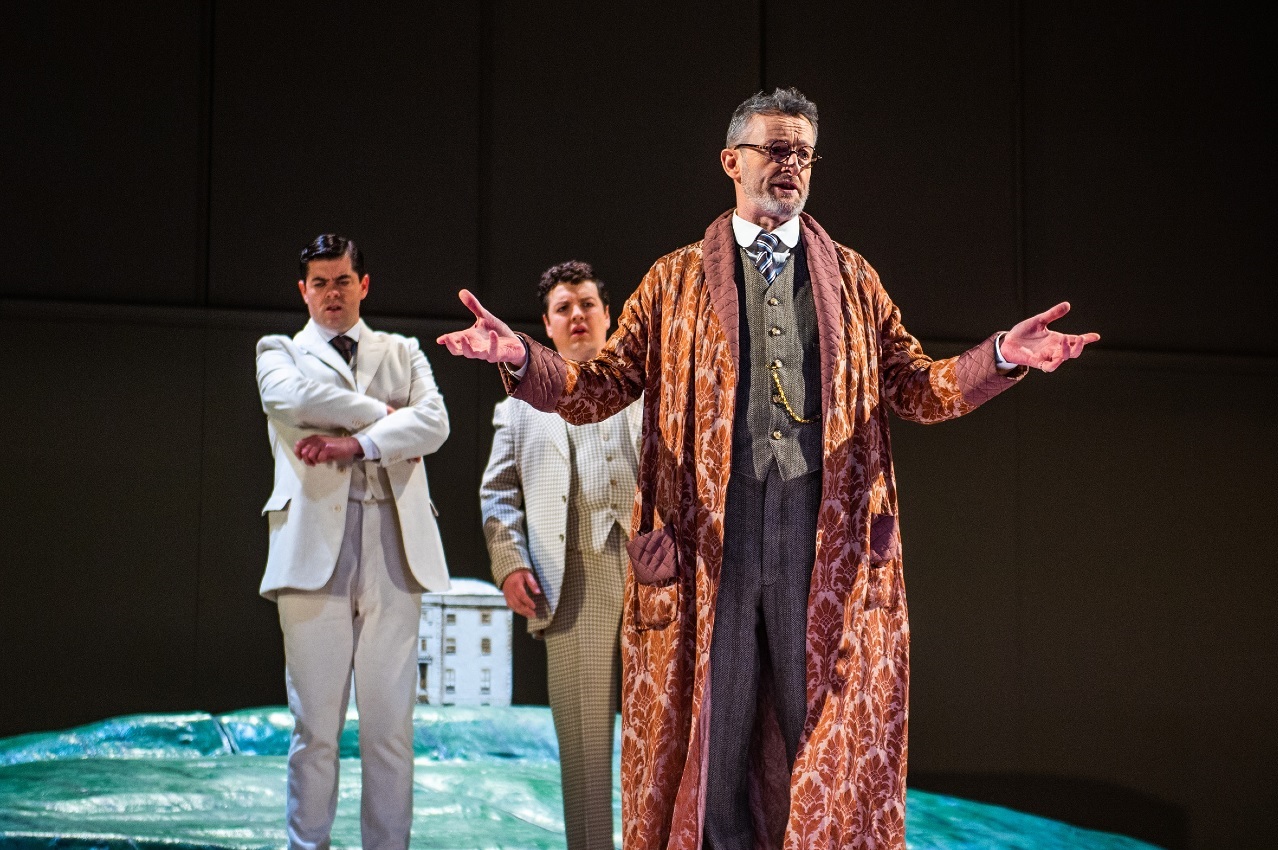
The resultant production design then was also something of a mixed bag. Sure, it has necessarily has to be basic in terms of set designs and effects, designer Jamie Vartan using projections to open it out a little and establish the period with newspaper articles and a sketched big house on the hill. I never quit grasped what the stately manor was about, other than perhaps how chorus of Irish women were treated as servants and second class citizens by the landed gentry. It wasn't a particularly impressive or eye-catching set, a huge hard plastic looking green blob representing a hill with a tiny 'big house' on top that was picked up and carried around by the cast for no discernable reason. Nor could I figure out the nature of Don Alfonso in this setting, walking around in a long house coat in a somewhat professorial manner with Ferrando and Guglielmo his students. None of it quite hit the mark.

To be fair, as ambitious as the Irish National Opera can be, even with reinterpretations of the standards of the opera repertoire, playing to the darker side of Così fan tutte is perhaps not really what they want to do with an opera buffa, particularly for a touring production. Leave that to the likes of Michael Haneke (Madrid, 2013) and Christophe Honoré (Aix-en-Provence, 2016). What they really want to get across is the wonder and beauty of Mozart, and there is no denying what we have here is a light and enjoyable production that certainly entertained the audience at the Gaiety in Dublin. Even though the Votes for Women scenes felt a bit forced in places, like a well meaning corrective for any misinterpretation of misogyny in the comedy. I have to admit, I enjoyed it more after the interval when I accepted the simple pleasure of seeing an amazing Mozart opera performed well, and was able to put aside any expectations of it having something significant to say.

There was certainly plenty to enjoy in the delivery of the singing performances. Anna Devin and Sharon Carty were everything you could hope for as Fiordiligi and Dorabella, their delivery bright and sparkling, filled with emotional sentiments, even if their predicament wasn't fully brought out in the direction of the acting. The same can be said for Dean Power's Ferrando and Benjamin Russell's Guglielmo. Neither were convincing in their disguises, but the emotional impact of the revelations they have about their girlfriends were wholly felt in their singing, which was powerful and true. The ever reliable John Molloy similarly made a great impression, even if his role as a manipulator was undervalued in the direction. On the other hand, Majella Cullagh delivered a fine comic performance in Despina's various guises and was the prime motivator in bringing the two sisters into the new sisterhood, but was slightly underpowered in her singing. It just shows how difficult all the singing roles are in Mozart - there are no secondary or minor roles here.

All credit to the principal roles then (and great idea of the INO to display the cast names in the surtitles as they took their bows at the curtain call), but you can't have any weaknesses at all in a meticulously constructed opera like this. The chorus played their part and the orchestra delivered the musical delights under the direction of Peter Whelan. The niggling inconsistencies in the setting and purpose were easily put aside then, as was any attempt to seek something deeper in Polly Graham's direction of the INO's Così fan tutte. The 'they're all the same' message here was simply that we all deserve to be loved and treated equally, and that was as truthful a reflection of the opera's intent as any.

Links: Irish National Opera

Sunday, 28 August 2022

Mozart - Idomeneo (Aix-en-Provence, 2022)


Wolfgang Amadeus Mozart - Idomeneo, Re di Creta

Festival Aix-en-Provence, 2022

Raphaël Pichon, Satoshi Miyagi, Michael Spyres, Sabine Devieilhe, Anna Bonitatibus, Nicole Chevalier, Linard Vrielink, Krešimir Špicer, Alexandros Stavrakakis

ARTE Concert - July 2022

There's no question that Mozart's operas are beautifully expressive of the whole range of human feelings and experience. Even at the age of 24 in his earliest masterpiece Idomeneo, Re di Creta he defies the often dry conventions and expectations of the opera seria format to create a work that imbues ancient Greek mythology with a rare humanity and authenticity. A stage director can choose to work to bring those human elements out, to interpret or reinterpret them, or they can quite reasonably rely on the music to speak for itself. That appears to be the intention of the director Satoshi Miyagi at this production for Aix-en-Provence 2022, but whether it supports Mozart's music or works against it is less certain.

There is certainly nothing wrong with updating the setting of Idomeneo or using it to express the original ideas and themes in a different context. I must admit I had my doubts about it being a neat fit for the director's proposed intention of using the Japanese wartime emperor Hirohito as a substitute for Idomeneus the King of Crete, or whether this would be in any other way meaningful or revelatory, but it has to be said that this notion never really asserts influence over the performance of the work here. What is far more significant to how the opera plays out in this production is decision to present it in a Noh drama fashion, with minimal but highly stylised sets and movements.

It certainly looks impressive, achieving the same kind of glacial quality that Robert Wilson employs in his opera and stage productions, and they are - usually but not always - none the worse off for it. Consequently, the principal performers here, dressed in stylised Japanese costumes, remain expressionless with minimal movement, often raised on their own platforms at a distance from one another. The chorus meanwhile, wearing more familiar military uniforms, merge with the sets, becoming part of them, part of the while fabric of the opera.

As far as that goes it's fine, the sets remain fluid and slowly moving and changing, ensuring that everything doesn't remain too static. If Idomeneo were a typical opera seria, it might not be enough to enliven the work and make the drama come to life, but despite the qualities of the music and the fact that it does indeed speak for itself, it seemed to me that it didn't do Mozart any favours. Not only does the intention to relate this to Hirohito and the Japanese people fail to make any impression - the opera has been staged as a modern post-war conflict much more successfully elsewhere in numerous updated productions - but it even seems to almost work against and neutralise the music, and that is not a good thing.

Fortunately it doesn't quite do that thanks to conductor Raphaël Pichon. If there are any doubts that remain about the quality of this early Mozart opera and how it stacks up against his mature works, this was certainly dispelled by the musical direction. Sure, the composition of Idomeneo can't compare to the great Mozart operas with Da Ponte, but much of what is great about those later works can already be heard developing here in a truly exciting way. It's a strong enough work on its own terms - more than strong and certainly if compared to what preceded it in opera seria, it's hugely progressive, devoid of the mannerisms and much more relatable, the characters really seeming to engage with one another and not just wrapped in their own worlds. Which, when you get right down to it, might just be what Mozart's operas are all about and what makes them great.

Unfortunately the production's stylised Noh influenced staging pushes the opera back onto those mannerisms, removing emotional connections, putting physical distance between the characters. I personally found Satoshi Miyagi's direction cold and distracting, at odds with Mozart's warm sympathetic and deeply expressive music. Worse, it simply offered no way in to relate to the plot and the drama to find a reason to care about each of the characters, much less offer an interpretation as to their motivations and behaviours as others have done, particularly into the complex nature and behaviours of Elettra and the king himself. There is no denying however that the set designs and the lighting were terrific and this was beautiful to look at, and it did suit the elegant formality of Mozart's music, if not bring out anything deeper from it.

Up until the conclusion, that is. A blood red backdrop is projected against the characters, showing them set against the horror and devastation that their decisions have caused. While mainly abstract in its human shapes and shadows cast against the horror of war, the suffering, the trauma, the eventual release and the recognition of the folly of its leaders acting like gods, it did hit home effectively, particularly with Mozart's music and with the soaring singing of the principals and chorus. It's here that Hirohito is most effectively evoked through the voice of the god Neptune, his broadcast voice coming from a record player that appears on its own raised platform. The slow and detached build-up might have been testing, but by the time the conclusion was reached, you were left in no doubt that this production did justice to Mozart, if perhaps not exactly find anything new in it.

Despite the impositions placed on the singers to remain mainly impassive and inexpressive, there was also much to enjoy in the singing. These are already challenging roles - Mozart composing this in 1781 for the best singers in Munich at the time - and the casting of the right kind of Mozartian voices is ideal for this production at Aix-en-Provence's Théâtre de l’Archevêché. If the director had little in the way of showing any nuance in the character of Idomeneo, who can be played sympathetically or as a misguided relic of the past who gets his just desserts, Michael Spyres's soft timbre brought warmth and humanity to the role. Soprano Sabine Devieilhe's singing brought more feeling and drama to the role of Ilia than the minimal direction allowed. Anna Bonitatibus as Idamante and Nicole Chevalier as Elettra were more constricted by their roles having little room for interpretation, but both sang superbly. With a cast like that and Mozart's music beautifully interpreted by Pinchon and the Pygmalion orchestra and chorus, the greatness of Idomeneo remains indisputable. 


Links: ARTE Concert, Festival Aix-en-Provence

Wednesday, 25 August 2021

Mozart - Don Giovanni (Salzburg, 2021)


Wolfgang Amadeus Mozart - Don Giovanni

Salzburger Festspiele, 2021

Teodor Currentzis, Romeo Castellucci, Davide Luciano, Mika Kares, Nadezhda Pavlova, Michael Spyres, Federica Lombardi, Vito Priante, David Steffens, Anna Lucia Richter

ARTE Concert - 8th August 2021

There are many facets to Mozart and Da Ponte's trilogy of operas, many facets of human behaviour that can be explored in them, universal traits that provide no easy answers to questions that on the surface can appear - and be played - as comedies but which underneath touch on some very disturbing subtexts. Don Giovanni can be depicted as villain or a victim of his own lusts - someone who loves too much, as someone who just isn't used to taking no for an answer, or in today's view, as a sexual predator and abuser of women. Don Giovanni is always worth a fresh perspective, but - perhaps more controversially (and it isn't often you can say that there is something more controversial in a production than the stage direction of Romeo Castellucci) - Mozart's score is also worth looking at in new ways. 

Teodor Currentzis has been upsetting those who like their Mozart played in the familiar Classical style for quite a while, but he's certainly not the only conductor finding more interesting facets to Mozart using historically informed direction on period instruments and using reduced ensemble orchestration. With Mozart's opera seria works that might be more palatable - and Salzburg have presented interesting Currentzis directed productions of La Clemenza di Tito in 2017 and Idomeneo in 2019 - but Don Giovanni is a different matter altogether. Rather than simply playing it to a way that has become rote and unadventurous over the years, Currentzis again seeks new ways to explore and express the wealth of character that is within Mozart's music. Forcing the listener to really listen to it. Making it feel fresh, shiny and new again. Like a virgin.

There's a theme that a director like Castellucci would certainly seize upon in a work like Don Giovanni, but there are less obvious ways to approach that. And there's maybe an allusion to stripping away the image of the sanctity of Mozart being forced into accepted conventional interpretations in the opening scene of Salzburg's Don Giovanni. In a white temple like setting, workmen strip away the Christian iconography of a church, leaving the elegant bare white edifice to show its basic underlying structure, ready to be built upon anew. A flame burns away any remaining holiness and indeed, the first person seen on the stage is a naked woman (well, it is Castellucci), one presumably no longer a virgin, since she has evidently been seduced/raped by Don Giovanni.

Rather than keep it simple and minimal, Castellucci then bombards the stage with all manner of effects, symbols and supernumeraries. A car crashes down on to the stage, a wheelchair, basketballs, a broken piano. Don Giovanni, Leporello and the Commendatore are dressed in white, while the avenging Donna Anna comes storming on in black with a retinue of Furies that surround and strive to bring Don Giovanni to justice for his crimes against women. It looks like Don Giovanni has juggled too many basketballs this time. The recitative as Don Giovanni and Leporello make their escape is played out with cartoon eyes on a black screen, Donna Anna mourns the crutch of Commendatore, Don Ottavio pours red powder on his arms and punctures a line of basketballs in his promise of securing revenge.

This is evidently not the Don Giovanni you might be familiar with but neither is it inappropriate to the tone of the work and its treatment by Mozart and da Ponte. It might do something different with the visuals and the pace, the use of instruments and emphasis of the music, but it still engages with the themes and the tone of the work. It's not so much Don Giovanni's debauchery and libidinous lifestyle that are condemned here as much as his failure to accept responsibility for and deal with the consequences of his actions. He leaves death and the destruction of lives behind him (something seized upon with a more political slant in Michael Haneke's version), including a suggestion that he has abandoned a pregnant Donna Elvira (Federica Lombardi doubled with a naked pregnant woman), while a child also pursues Don Giovanni on the stage.

The lightness of the treatment and the heaviness of the underlying implications is borne out in the music. Leporello's 'Madamina, il catalogo è questo' has a lovely lightness, the piano weaving in and out of the musicAeterna arrangement, the beauty of the aria contrasted with the sinister note behind the revelations of conquests. Castellucci provides plenty of contrasting imagery, mixing the absurdity with the comedy, with pointed symbolism and contemporary references that include a photocopier. Likewise he brings Michael Spyres's Don Ottavio on wearing a Danish mountaineer outfit (a familiar inscrutable symbol also used in his Moses und Aron) accompanied by a poodle. It looks ridiculous (several characters have a live animal avatar - Masetto a mouse, Don Giovanni a goat) but takes nothing away from the chilling account of Donna Anna on the recognition of her father's murderer, the scene re-enacted as a Greek tragedy.

Which is something that the legend of Don Giovanni could certainly be said to aspire to, it not being entirely out of place with the opera seria reworkings of mythology that preceded Mozart in the earlier part of the 18th century. Just as Mozart brought a contemporary edge to that genre in his progressive music and Da Ponte in the humanisation of the drama while still retaining the otherworldly elements that elevate it to grand drama - so Castellucci brings a corresponding touch of re-interpretation of an epic myth for a modern age while reflecting and respecting the underlying complexity of the work's blend of surrealism, comedy, tragedy, symbolism and instruction on the consequences of moral dissolution. In an expansive gesture that brings 150 women as extras to the stage, Don Giovanni here is held to account for his crime not by a stone statue, but by the women he has wronged. 

Teodor Currentzis seems to be doing his best to submerge as much as possible any of Mozart's familiar melodic embellishments. Whether this is for the sake of upsetting those who like their Mozart played in a conventionally acceptable way, whether it's out of sheer bloody-mindedness to stake out is reputation for being a fearless re-interpreter of Mozart, or whether he finds it appropriate to reevaluate and strip away the varnish of mannerisms that the work has accrued over the years and present a more historically informed account of the score is something the musicologists can argue over. Aligned with the drama an Castellucci's sensibility, the music however doesn't lose a fraction of its distinctive Mozartian qualities of beauty, sensitivity or dramatic flair.

Think what you might also of Romeo Castellucci's contribution, whether it adds any value or provides any new insights but - much like his stunning Die Zauberflöte for La Monnaie - it's certainly original, often spectacular and rarely dull, always surprising with some new idea that puts emphasis on different aspects of the work. It's also not without the occasional bit of flash/bang showmanship, which Mozart wasn't beyond employing himself. Castellucci has become a stylist in white haze, his productions as distinctive now as Robert Wilson's geometric minimalism in blue, and just as visually arresting in their conception, design and execution. This looks simply stunning and impressively choreographed.

It has to be said however, that it's more of an "interesting" production than a great one. Despite the efforts to bring "real people" onto the stage (see Castellucci's rather more successful Die Zauberföte again) and the impressive efforts to pull it all together into a coherent whole, it doesn't always succeed in finding the human warm within the work where it traditionally should. The idea of making Don Giovanni and Leporello look almost identical is another fine idea that makes the identity confusion more realistic, but it also loses something when the two baritones are practically indistinguishable.

Perhaps just as much at fault as the production, the singing didn't quite measure up or compensate for the lack of human warmth in the production. The singing is generally fine, and of a very high standard, as you would expect, but despite good performances from Davide Luciano as Don Giovanni (stripped fully naked at the finale) and Vito Priante as Leporello, and with perhaps the sole exception of a mighty performance from Nadezhda Pavlova as Donna Anna, the production never allowed you to engage with any of the characters of at least sympathise with their dilemma. Overall, this feels like an admirable production with good ideas and visuals, that despite its controversial trappings, plays out nonetheless in a rather run of the mill fashion.

Links: Salzburg Festival, ARTE Concert

Friday, 28 August 2020

Handel / Mozart - Der Messias (Salzburg, 2020)

George Frideric Handel / Wolfgang Amadeus Mozart - Der Messias

Mozartwoche Salzburg, 2020

Marc Minkowski, Robert Wilson, Elena Tsallagova, Wiebke Lehmkuhl, Richard Croft, José Coca Loza

Unitel Classica - Blu-ray

Putting aside the sheer beauty of the aesthetic of a visual artist who paints with light and shapes, the success of Robert Wilson's unique style and direction, I find, is down to his ability to touch on the spiritual nature of music in his abstract designs without needing to slavishly serve the conventional narrative form of the drama. Evidently that works well in works that stretch the opera form like Pelléas et Mélisande or Arvo Pärt's Adam's Passion, but even in a work with no apparent ambitions towards spirituality as Einstein on the Beach or in a work as conventionally opera-dramatic as Il Trovatore he sometimes manages it as well - perhaps finding something spiritual in the less familiar French language version in the case of the latter.

There are similar gaps to explore between traditional expectations and boundaries in this less familiar German version of Handel's Messiah. The original work itself of course has a beautiful spiritual dimension, and if the purpose or intent of the oratorio is to embody the essence of godliness, Wilson is well equipped to do that. Intriguingly however the work was arranged with new instruments and in the German language by Mozart, another great composer who also had a deep feeling for the spiritual side of humanity, who would himself contribute a considerable body of his work to religious music, masses and of course in his famous requiem. There's an intriguing crossover there, an exploration and reworking of one great composer's work by another to his own idiom and that presents a fascinating musical world for a conductor to explore, and for a director like Robert Wilson to present.

Quite how you would begin to describe Wilson's approach to Der Messias, much less evaluate it, doesn't seem at all worthwhile. In a light-boxed and light-framed stage he captures transitions in mood, sentiment and meaning in a shifting of light, in the change of a colour tone, a blast of bright godly light or fading light like the setting of the sun, from glory to quiet contemplation. The projections of nature and floating natural objects add another element not always used in the artificial reality and geometric shapes of Wilson productions. A log, a stick, a tree with roots, waves gently rolling, huge shifting and crashing icebergs. And within this figures are precisely posed, Richard Croft dressed up like a Bob Hope music hall entertainer, winking and nodding to the audience, Elena Tsallagova a more angelic presence (and voice), with dancers and other enigmatic figures making appearances.

You might have a problem with this abstraction, but only if you try to apply or impose meaning or interpretation upon it. It can distract from following the expression of Charles Jennens's libretto (although that has a complicating factor in it being sung in German, so is not as 'direct' as you might be familiar with). Not that Jennens's words are transparent or direct in any case, but if they take on renewed meaning here it's because of Mozart's beautiful version of the score, a wonderful blend of Handel's composition and Mozart's musical and instrumental rearrangement. Not that you can find Wilson's contribution indifferent. As is often the case, even if it sounds like a cop out, is that you have to do is let Wilson transport you into his vision and feeling for the piece. It will work for some, not so much for others, but it is beautiful hypnotic and involving in its own way.

Inevitably, there is always a sense of coldness and formality about a Robert Wilson production, which when aligned with the archaic expression of Jennens makes the message of the Messiah feel as if it were something encased in ice. That may sound unkind, but there is something to that view of religious formality and purity that doesn't permit any flaws or imperfections. Wilson embraces this, finds the beauty within it and seeks to almost glorify it and in his own way break through the ice to the message of warmth, of peace and of hope for humanity. Which was perhaps also Mozart's intention in taking the outdated musical style of oratorio and bringing his own human touch to the greatness that lies within Handel's icy perfection.

Whether he succeeds and whether you ascribe to the Wilson view of opera and theatre direction or not is a matter for the individual viewer, but it's unquestionably original. If you go with that (ice) flow however, there's every possibility that you can look at Handel's Messiah in an entirely new way. The contribution of Mozart's Classical Viennese reworking of Handel can't be discounted for the power and majesty of the music alone, and unsurprisingly Handel sounds natural in German. In terms of interpretation it is quite wonderful under Marc Minkowski and his Les Musiciens du Louvre. Elena Tsallagova, Wiebke Lehmkuhl, Richard Croft and José Coca Loza all likewise go a considerable way to ensure that even though almost entirely devoid of any religious connotation, the majesty of the work and its uplifting message for humanity comes through clearly.

Any Robert Wilson production in High Definition is always a treat and the image on this Blu-ray release from Unitel Classica of the 2020 Mozart Week Salzburg performance captures the muted blue/grey colour tones and the gradations of light and shadow beautifully. The 48kHz/24 bit High Resolution LPCM and DTS-HD Master Audio 5.1 audio tracks are no less impressive a soundstage for the wonderful musical performances and outstanding soloist and choral singing. Other than trailers, there are no extra features on the disc, just some background information in the enclosed booklet on how Mozart's version came into being and some consideration of the ideas employed by Wilson. The region-free Blu-ray has subtitles in German, English, French, Korean and Japanese.

Links: Mozartwoche Salzburg